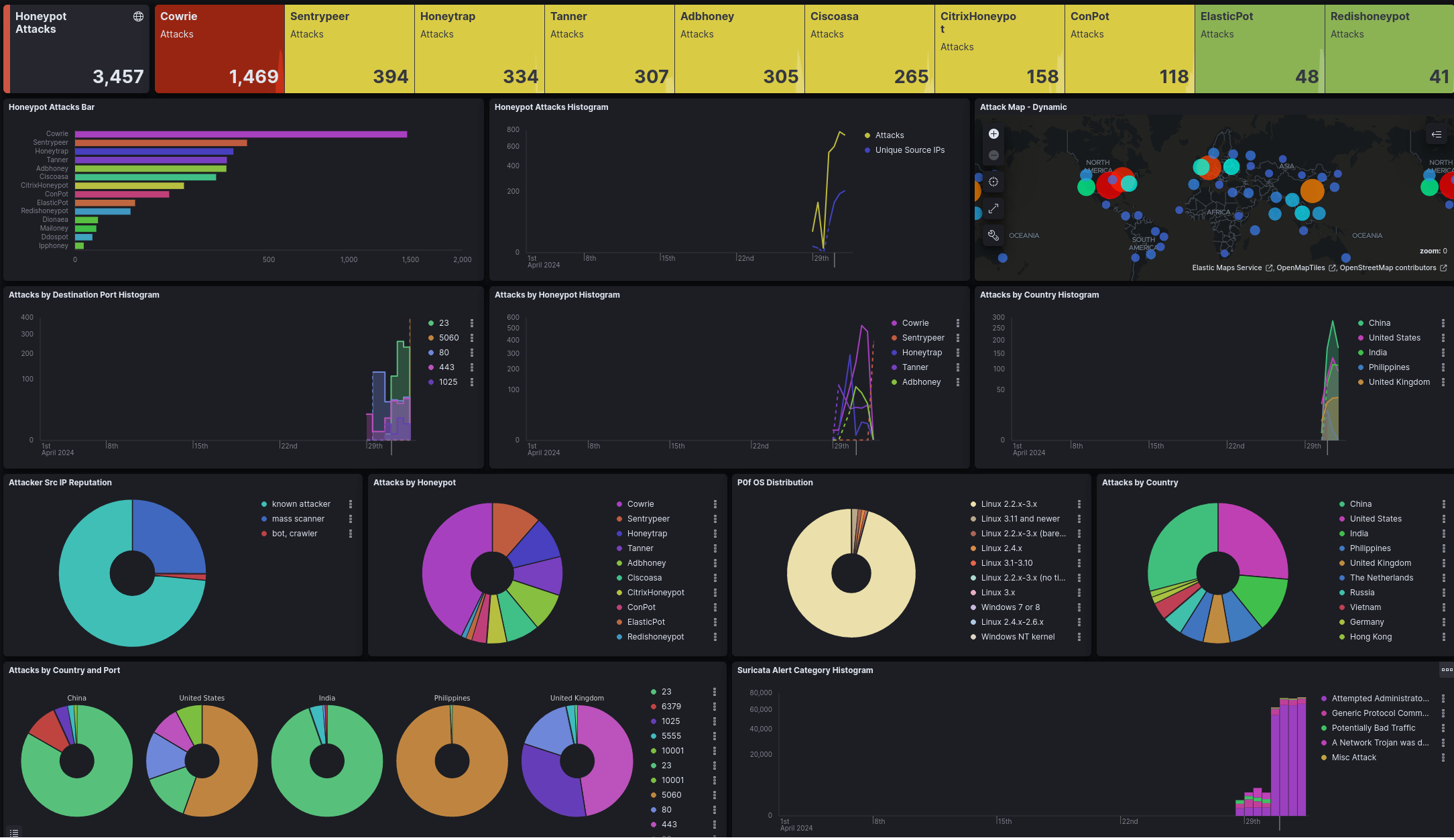
I’ve set up a honeypot using T-POT. This honeypot simulates vulnerable services & traps malicious actors, providing invaluable data for threat analysis & mitigation strategies.
This project helps me to visualize & track daily attacks & attackers that are active across the internet. I can research specific IP address, known attackers, known attacks, compare to CVE’s, & check my own network device vulnerabilities against attacks that are in use.
What is T-POT?
T-POT, which stands for “Threat Intelligence Pot”, is an open-source honeypot framework designed to automate the deployment & management of honeypots for network security monitoring & threat intelligence gathering. It aims to simplify the process of setting up various types of honeypots & collecting data on potential threats.
https://github.security.telekom.com/2024/04/honeypot-tpot-24.04-released.html#technical-architecture
ADB Honey
ADB Honey is a honeypot designed to emulate Android Debug Bridge (ADB) servers, which are used for debugging & managing Android devices remotely. ADB Honey is specifically crafted to attract & monitor attacks targeting ADB servers.
Android Debug Bridge (ADB) is a versatile command-line tool that allows developers to communicate with an Android device from a computer over a USB connection or a network connection. It provides various functionalities, such as installing & debugging apps, accessing the device’s shell, transferring files, & more.
ADB Honey operates by simulating an ADB server, thereby appearing as a legitimate target to potential attackers scanning the network for vulnerable ADB instances. Once attackers interact with the honeypot, ADB Honey captures information about the attempted exploits, commands executed, & any malware payload delivered, enabling security researchers to analyze the attack techniques & gather threat intelligence.
CiscoASA
The CiscoASA honeypot is a specialized honeypot designed to emulate Cisco ASA (Adaptive Security Appliance) devices, which are widely used for network security & VPN (Virtual Private Network) solutions. Cisco ASA devices are commonly deployed in enterprise environments to provide firewall, intrusion prevention, VPN, & other network security functionalities.
The CiscoASA honeypot within the T-POT framework simulates the behavior of a Cisco ASA device, including its configuration, services, & responses to network traffic. By emulating a Cisco ASA device, the honeypot aims to attract & intercept attacks targeting these types of security appliances.
Attackers often target Cisco ASA devices to exploit vulnerabilities, gain unauthorized access, or conduct reconnaissance activities within corporate networks. By deploying a CiscoASA honeypot, security professionals can monitor & analyze the tactics, techniques, & procedures (TTPs) used by attackers against Cisco ASA devices without exposing real infrastructure to risk.
Citrix Honeypot
The Citrix honeypot is a specialized honeypot within the T-POT framework designed to emulate Citrix NetScaler devices. Citrix NetScaler is a widely used application delivery controller (ADC) & load balancer solution that provides various networking & security functionalities, including traffic management, SSL offloading, application firewall, & remote access.
The Citrix honeypot simulates the behavior of a Citrix NetScaler device, including its configuration, services, & responses to network traffic. By emulating a Citrix NetScaler device, the honeypot aims to attract & intercept attacks targeting these types of network infrastructure devices.
Attackers may target Citrix NetScaler devices to exploit vulnerabilities, gain unauthorized access, or conduct reconnaissance activities within corporate networks. By deploying a Citrix honeypot, security professionals can monitor & analyze the tactics, techniques, & procedures (TTPs) used by attackers against Citrix NetScaler devices without exposing real infrastructure to risk.
Conpot
Conpot is an open-source ICS/SCADA (Industrial Control Systems/Supervisory Control & Data Acquisition) honeypot framework designed to emulate industrial control system protocols & services. It is specifically tailored to attract & monitor attacks targeting critical infrastructure components, such as programmable logic controllers (PLCs), human-machine interfaces (HMIs), & other SCADA devices.
Conpot allows security professionals to deploy virtualized instances of industrial control system components, simulating their behavior & responses to network traffic. By emulating these components, Conpot aims to deceive attackers into interacting with the honeypot, thereby capturing information about their tactics, techniques, & procedures (TTPs).
Some key features of Conpot include:
- Emulation of Industrial Protocols: Conpot supports emulation of various industrial protocols, including Modbus, S7Comm, DNP3, Ethernet/IP, & others commonly used in SCADA & ICS environments.
- Realistic Responses: The framework provides realistic responses to network requests, mimicking the behavior of legitimate industrial control devices.
- Data Collection: Conpot captures & logs network traffic, commands, & interactions with the honeypot, allowing security analysts to analyze attacker behavior & gather threat intelligence.
- Integration with T-POT: Conpot can be integrated into the T-POT framework, allowing users to deploy & manage multiple honeypots, including SCADA/ICS honeypots, in a unified environment.
Cowrie
Cowrie is a popular medium-interaction SSH (Secure Shell) & Telnet honeypot designed to capture & log attempted attacks against SSH & Telnet services. It emulates a vulnerable SSH/Telnet server, attracting attackers who attempt to exploit common vulnerabilities or gain unauthorized access to systems.
Key features of Cowrie include:
Emulation of SSH/Telnet Services: Cowrie simulates the behavior of SSH & Telnet services, presenting itself as a legitimate target for attackers scanning the internet for vulnerable systems.
Interaction Logging: The honeypot logs all interaction attempts made by attackers, including login attempts, commands executed, & file transfer requests.
File System Emulation: Cowrie emulates a file system structure, allowing attackers to navigate directories & interact with fake files & directories.
Session Capture: Cowrie captures full session data, including keystrokes & terminal output, providing valuable insight into attacker behavior & techniques.
Integration with T-POT: Cowrie can be integrated into the T-POT framework, allowing users to deploy & manage multiple honeypots within a unified environment.
Ddospot
DDoSPot is a honeypot “platform” for tracking & monitoring UDP-based Distributed Denial of Service (DDoS) attacks. The platform currently supports following honeypot services/servers in form of relatively simple plugins called pots:
- DNS server
- NTP server
- SSDP server
- CHARGEN server
- Random/mock UDP server
Dicompot
Dicompot, also known as “Dionaea with Conpot”, is a combination of two honeypots: Dionaea & Conpot.
Dionaea: Dionaea is a high-interaction honeypot designed to capture & analyze malware samples & exploits targeting vulnerable services like SMB (Server Message Block), HTTP, & FTP (File Transfer Protocol). It emulates various services & waits for attackers to interact with them, capturing information about their activities, including the malware they attempt to download or execute.
Conpot: Conpot is an ICS/SCADA (Industrial Control Systems/Supervisory Control & Data Acquisition) honeypot that emulates industrial control system protocols to attract & study attacks targeting critical infrastructure. It simulates the behavior of industrial devices, such as PLCs (Programmable Logic Controllers) & HMIs (Human-Machine Interfaces), to gather intelligence on threats to industrial environments.
When combined as Dicompot, these two honeypots work together to provide comprehensive coverage for both IT & OT (Operational Technology) environments. Dicompot allows security professionals to monitor & analyze attacks targeting both traditional IT infrastructure & industrial control systems, providing valuable insights into the tactics, techniques, & procedures used by attackers across different sectors.
Dionaea
Dionaea is a high-interaction honeypot designed to capture & analyze malware samples & exploits targeting vulnerable services. It emulates various network services such as SMB (Server Message Block), HTTP, FTP (File Transfer Protocol), & others to attract & interact with potential attackers.
Key features of Dionaea:
Emulation of Vulnerable Services: Dionaea simulates the behavior of real services with known vulnerabilities, making it appear as a legitimate target for attackers scanning the internet for vulnerable systems.
Malware Capture: When attackers interact with Dionaea, the honeypot captures any malware samples or exploits they attempt to download or execute. This allows security analysts to analyze the malware & understand its capabilities.
Interaction Logging: Dionaea logs all interaction attempts made by attackers, including connection attempts, commands executed, & file transfer requests. This information provides valuable insight into attacker behavior & techniques.
Protocol Support: Dionaea supports multiple protocols, including SMB, HTTP, FTP, & more, allowing it to capture a wide range of malicious activity targeting different services.
Endlessh
Endlessh is a lightweight, open-source SSH tarpit (or SSH honeypot) designed to slow down & frustrate SSH brute-force attacks. It works by accepting incoming SSH connection attempts but deliberately delaying the connection process, making it time-consuming for attackers to determine whether the connection attempt was successful.
Key features of Endlessh include:
Tarpitting: Endlessh slows down SSH connection attempts by delaying the negotiation process. This effectively wastes the time of attackers attempting to brute-force SSH credentials, making their efforts less efficient.
Minimal Resource Usage: Endlessh is designed to be lightweight & consumes minimal system resources. It can run on low-powered devices or servers without significantly impacting performance.
Logging: Endlessh logs all connection attempts, including the source IP addresses & timestamps. This information can be valuable for analyzing brute-force attempts & identifying potential attackers.
Easy to Deploy: Endlessh is easy to deploy & configure, making it accessible for both experienced sysadmins & novice users interested in enhancing their SSH security.
Heralding
Credentials collector. Currently the following protocols are supported: ftp, telnet, ssh, http, https, pop3, pop3s, imap, imaps, smtp, vnc, postgresql & socks5.
https://github.com/johnnykv/heralding/blob/master/README.rst
IPPHoney
IPPHoney is a low-interaction honeypot designed to emulate Internet Printing Protocol (IPP) printers. IPP is a protocol used for printing documents over the Internet & local networks. IPPHoney is specifically crafted to attract & monitor attacks targeting IPP printers.
Key features of IPPHoney include:
Emulation of IPP Printers: IPPHoney emulates the behavior of IPP printers, making it appear as a legitimate printer on the network.
Logging: The honeypot logs all interaction attempts made by attackers, including print job requests & configuration queries.
Detection of Attacks: IPPHoney captures information about potential attacks targeting IPP printers, such as attempts to exploit vulnerabilities or gain unauthorized access.
Threat Intelligence Gathering: By deploying IPPHoney, security professionals can gather intelligence on the tactics, techniques, & procedures (TTPs) used by attackers targeting IPP printers.
Log4Pot
A honeypot for the Log4Shell vulnerability
- Listen on various ports for Log4Shell exploitation.
- Detect exploitation in request line & headers.
- Download exploit payloads recursively.
- Log to file & Azure blob storage.
Mailoney
Mailoney is a high-interaction honeypot designed to emulate email services, such as SMTP (Simple Mail Transfer Protocol) servers, to attract & monitor malicious activities targeting email infrastructure. It is specifically crafted to mimic the behavior of real email servers, making it appear as a legitimate target for attackers attempting to exploit vulnerabilities, send spam, or conduct phishing campaigns.
Key features of Mailoney include:
Emulation of Email Services: Mailoney simulates the behavior of SMTP servers, allowing it to accept incoming email connections, receive email messages, & respond to email-related requests.
Logging: The honeypot logs all email-related activities, including connection attempts, email delivery attempts, message content, sender information, & recipient information.
Detection of Malicious Activity: Mailoney captures information about potential threats targeting email infrastructure, such as attempts to exploit vulnerabilities, deliver malware-laden attachments, or send unsolicited bulk emails (spam).
Threat Intelligence Gathering: By deploying Mailoney, security professionals can gather intelligence on the tactics, techniques, & procedures (TTPs) used by attackers targeting email services, helping organizations improve their email security posture & defend against email-based threats.
Medpot
Redishoneypot
Redishoneypot is a type of honeypot designed to emulate Redis servers. Redis is an open-source, in-memory data structure store that is commonly used as a database, cache, or message broker. Redishoneypot aims to attract & monitor attacks targeting Redis servers, such as unauthorized access attempts, exploitation of vulnerabilities, or reconnaissance activities.
Key features of Redishoneypot may include:
Emulation of Redis Protocol: Redishoneypot simulates the behavior of a real Redis server, responding to commands & requests as if it were a legitimate Redis instance.
Logging & Monitoring: The honeypot logs all interaction attempts made by attackers, including commands executed, connection attempts, & responses received. This information can help security professionals analyze attacker behavior & identify potential threats.
Detection of Attacks: Redishoneypot captures information about potential attacks targeting Redis servers, such as attempts to exploit known vulnerabilities or abuse Redis functionality for malicious purposes.
Threat Intelligence Gathering: By deploying Redishoneypot, organizations can gather intelligence on the tactics, techniques, & procedures (TTPs) used by attackers targeting Redis infrastructure. This information can be used to improve security defenses & mitigate risks associated with Redis deployments.
SentryPeer
SentryPeer® is a fraud detection tool. It lets bad actors try to make phone calls & saves the IP address they came from & number they tried to call. Those details can then be used to raise notifications at the service providers network & the next time a user/customer tries to call a collected number, you can act anyway you see fit.
Snare
Snare is a medium-interaction honeypot designed to emulate a Windows environment, specifically targeting SSH & Telnet protocols. It is often used to capture & analyze attacks targeting Windows-based systems.
Key features of Snare include:
Emulation of Windows Environment: Snare simulates the behavior of a Windows system, including responding to SSH & Telnet connection attempts as if it were a legitimate Windows server.
Medium Interaction: Snare provides a level of interaction that is more realistic than low-interaction honeypots but less resource-intensive than high-interaction honeypots. This allows it to capture a wide range of attack techniques while minimizing the risk of compromise.
Logging & Monitoring: Snare logs all interaction attempts made by attackers, including commands executed, login attempts, & file transfer requests. This information is valuable for analyzing attacker behavior & identifying potential threats.
Detection of Attacks: Snare captures information about potential attacks targeting Windows systems, such as attempts to exploit vulnerabilities, gain unauthorized access, or execute malicious commands.
Threat Intelligence Gathering: By deploying Snare, organizations can gather intelligence on the tactics, techniques, & procedures (TTPs) used by attackers targeting Windows environments. This information can be used to improve security defenses & mitigate risks associated with Windows-based systems.
Wordpot
Wordpot is a medium-interaction honeypot designed to emulate vulnerable WordPress installations. It is specifically crafted to attract & monitor attacks targeting WordPress-based websites.
WordPress is one of the most popular content management systems (CMS) used to build websites & blogs. Due to its widespread adoption, WordPress sites can be targets for attackers seeking to exploit vulnerabilities or gain unauthorized access.
Key features of Wordpot include:
Emulation of WordPress: Wordpot simulates the behavior of a WordPress website, including presenting itself as a legitimate target for attackers scanning the internet for vulnerable WordPress installations.
Medium Interaction: Wordpot provides a level of interaction that is more realistic than low-interaction honeypots but less resource-intensive than high-interaction honeypots. This allows it to capture a wide range of attack techniques while minimizing the risk of compromise.
Logging & Monitoring: Wordpot logs all interaction attempts made by attackers, including login attempts, plugin & theme installations, & malicious file uploads. This information is valuable for analyzing attacker behavior & identifying potential threats.
Detection of Attacks: Wordpot captures information about potential attacks targeting WordPress websites, such as attempts to exploit known vulnerabilities, brute-force login attempts, or injection attacks.
Threat Intelligence Gathering: By deploying Wordpot, organizations can gather intelligence on the tactics, techniques, & procedures (TTPs) used by attackers targeting WordPress sites. This information can be used to improve security defenses & mitigate risks associated with WordPress-based websites.

Multi-disciplinary IT support strategist with 15+ years experience empowering entrepreneurs, corporate colleagues and remote teams with the knowledge, skills and technologies to get stuff done. | Sec+ – CySA+ (CSAP) – ITIL – ACSP
Comments are closed.